

Roberto Henriquez
Roberto Henríquez
Discover the natural wines of Roberto Henriquez and the work he does on vines over 200 years old. País, Muscat d'Alexandrie, Chasselas, Corinto and Sémillon are the grape varieties he handles masterfully.
12 products


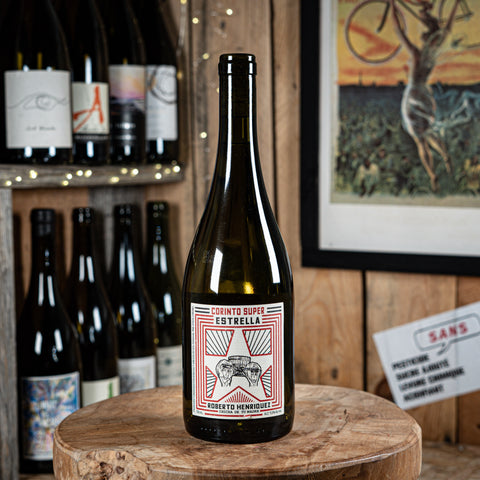


The wines of Roberto Henriquez
Roberto Henriquez and natural wine
We travel for you at Epi-curieux. We crossed the Atlantic and landed in Chile to meet Roberto Henriquez, whose wines come from vines over 200 years old, on a very fresh terroir. He believes in traditional winemaking methods, and we thank him for that! His wines are absolutely incredible and well worth discovering.
Bio Bio and Itata according to Roberto Henriquez
Born in Concepción, Chile, in 1984, Roberto Henriquez grew up in the world of wine thanks to his uncle. He studied agronomy and oenology, then travelled the world to soak up the wine cultures of different countries, learning from winemaking practices in France, Canada, South Africa and of course Chile.
In France, Roberto met Domaine Mosse, and Joseph Mosse himself came to Chile for 6 months in 2014 to discover Chilean viticultural practices, an enriching adventure for both. Convinced of the potential of his land and of natural winemaking, Roberto Henriquez put into practice everything he had learned.
In May 2015 he set up on his own, in the southern regions of Bio Bio and Itata. The vines there are over 200 years old, a piece of luck since phylloxera never took hold in this area. Roberto is one of those winemakers who believe in zero inputs, especially in this part of Chile's old south. This vision does not reflect mainstream Chilean wine culture, which tends to look down on traditional methods. The soils are very diverse, particularly in Bio Bio, with granite, quartz, red clay, basalt and alluvium.
The climate helps keep freshness, with a cool spring, summer temperatures that do not exceed 30 degrees, and a fairly short transition from autumn to winter. Altitude is another feature of Roberto's wines: his vines lie on south-facing slopes between 200 and 400 metres. Biodiversity is present too, with crops such as maize and fruit planted along the vines.
The cuvées of Roberto Henriquez
Roberto harvests by hand and the grapes are destemmed. The juice then starts fermenting in concrete tanks or old oak barrels. The wines are unfiltered, and sulphites are added only if necessary. Roberto Henriquez farms 7 hectares of vines on 4 different plots near the Cordillera de Nahuelbuta. His grape varieties are País for the reds and Muscat of Alexandria, Chasselas, Corinto and Sémillon for the whites. Epi-curieux has selected cuvées for lovers of natural red wines, and especially for those who love País.
Though Roberto Henriquez works with very old vines, their ideal exposure keeps a great deal of freshness in his wines, with plenty of fruit and spice.
The Rivera del Notro Tinto cuvée, from the Biobio region, comes from pre-phylloxera País vines aged 150 to 200 years. A two-week carbonic maceration keeps the best of the fruit. A fine signature from the winemaker!
In the Santa Cruz de Coya cuvée, the País is over 200 years old, bush-trained on granite and alluvial soils. It has 2 weeks of skin maceration, destemmed as always, with gentle punching down every day for a week, and ageing in wood. This 100% País is vegetal, spicy, fruity and fresh… everything we love.
Welcome to the Cordillera de Puma, on granite soils, with Tierra de Pumas, also 100% País. The destemmed maceration lasts 3 weeks in tanks, and ageing is 90% in cement tanks and 10% in barrels.
The last 100% País is the Franco cuvée, a fine expression of terroir, harvested on alluvial soil at 800 m above sea level on the banks of the Biobio. The vines are over 200 years old, the maceration is destemmed and ageing takes place in cement tanks.
Our favorite wines ❤️
We tasted, we loved it! No mistake with these bottles!







100% grapes

Fast shipping

Delivery from €7